My First Game: How I Built NYSC World, a Multiplayer Nigerian Life-Sim
LagosLife's launch pushed me to build my first game as my service year wrapped up. How a web designer built a multiplayer NYSC life-sim in the browser.
 Eric Boluwatife
22 October 2026 · 9 min read · Updated 23 October 2026
Why nowWritten the week NYSC World went live, while I was rounding up my own service year.
Before NYSC World, I had never built a game. Not a platformer, not a puzzle, nothing. I design and build websites, web apps and brands for a living.
Then LagosLife launched. It's a game about life in Lagos, and it landed while I was rounding up my own service year. Seeing it go live flipped a switch: if someone could put Lagos into a game, why couldn't I build one around the year I was living through? Nobody asked me to. I took it on as a challenge to myself, with one question I couldn't let go of: what would it take to put the Nigerian service-year experience inside a browser, and let real people live it together?
The honest answer was "a lot of things you don't know how to do yet." That's exactly why I said yes.
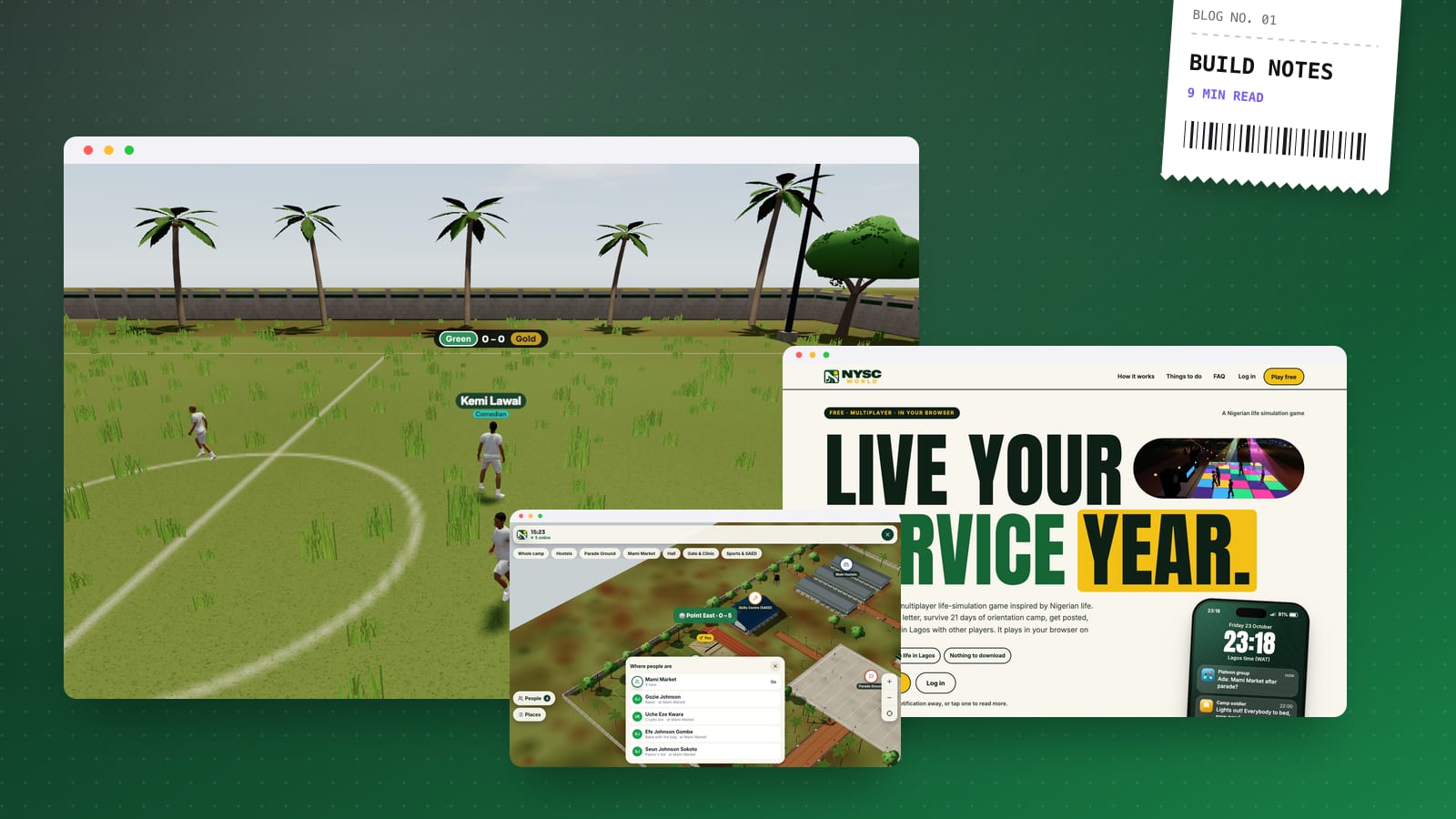
NYSC World is the result: a free multiplayer life-sim you play in your browser, from your call-up letter to a life in Lagos. You can play it at nyscworld.com. This is the story of how it came together, what I had to learn, and why taking on work I've never done before is how I get better at the work I do every day.
A quick but important note: NYSC World is a fictional game inspired by everyday Nigerian life. It is not affiliated with, endorsed by or connected to the National Youth Service Corps or any government body. It uses its own branding, fictional organisations and fictional vendors, with no official logos or insignia.
Why a game, and why this one?
Almost every Nigerian graduate has a camp story. The call-up letter. The bus ride with strangers who become friends by the second toll gate. The whistle before sunrise, the parade ground, the market where half the friendships start, and the soldier who somehow always knows you're the one who's late.
That shared, chaotic rite of passage felt like the perfect front door for a social game. Everyone who's been through it has something to say about it, and everyone who hasn't is curious.
The timing made it personal. I was in the last stretch of my own service year, with the camp, the CDS days and the posting all fresh in my head. I wasn't researching the experience; I was living it.
I also wanted to prove something to myself. Most of my work lives in a browser, so I know what a browser can do. A real-time 3D world with dozens of people in it, running on an ordinary Android phone over mobile data, sat right at the edge of that. I wanted to find the edge and push past it.
The storyline: one year, told in stages
I wrote the game the way the year actually unfolds, so every stage has its own screens, rules and mood.
- Your call-up letter arrives. You create your character (name, state of origin, look and personality), receive your posting to camp from a fictional service board, pay your bus fare and ride in.
- You walk through the camp gate. Registration first: bed space, kit and ID card at the multipurpose hall. You arrive in your own clothes and change into camp whites once you're registered.
- You live 21 days of camp. The game runs on a real-time West Africa clock, so morning parade happens in the morning and the night is actually night. There are lectures, skills sessions, sports on the field, the Mami market for trading and gossip, and the camp radio playing in the background.
- You follow the rules, or face the consequences. Soldiers patrol. Miss lights-out and you'll be escorted back to your hostel; be late and you might land punishment duty. The hostel gets locked at set times, and twenty minutes before lights-out you get a warning to start walking.
- You get paid, like everyone else. Camp allowances land on fixed days in fictional naira, and you decide whether to save, spend at the market or lend a friend.
- You get posted. At passing out, you're posted to a district in Lagos with a place of assignment, a community development group and a lodge to sleep in while you find a place to rent.
- You build a life. Rent a room, furnish it, take a danfo, keke or okada across town, pick up side hustles, make friends and go out at night.
The design rule I kept coming back to was simple: real players matter more than clever NPCs, and fun beats realism whenever the two disagree. Camp should feel like camp, but it should never feel like homework.
Brand before code
Because I'm a designer first, the game got a proper identity before it got a single line of gameplay: an N drawn as a road under a rising sun, with Nigeria marked at the start of the journey, in deep greens and sun yellow. It had to work at 16 pixels as a favicon and at full screen as a loading screen.
Having the brand settled early made hundreds of small decisions easier, from the colour of the in-game phone to the posters I made to launch it. It's the same reason I design brand identities before building websites for clients.
What I had to learn from zero
This is the part I enjoyed most. Nearly every system in the game was new to me.
A 3D world that runs on a phone
I compared Three.js, Babylon.js, PlayCanvas, Unity and Godot against one question: what loads fast and runs smoothly in a mobile browser on a mid-range phone? Three.js won. Its core is small, it gave me full control over performance, and everything is plain code I can read and change.
I set myself a hard budget: no more than 150 draw calls with around 60 players on screen. To hit it, I learned instancing (drawing many similar characters in one go), level of detail (simpler models in the distance) and merging static buildings by material. In my own tests with 60 networked players, mostly scripted bots, on emulated mobile settings, the scene stayed at roughly 30 draw calls. Testing on a wide range of real phones is still ongoing.
Multiplayer where the server is always right
Multiplayer was the biggest leap. I built it on Colyseus, with one rule above all: the server is authoritative. Your phone never tells the server where you are or how much money you have. It sends intentions ("I'm walking this way", "I want to buy this") and the server decides what happens.
To make movement still feel instant, the game predicts your movement locally and corrects it when the server answers, while other players are smoothly interpolated. Each player only receives updates about people near them, and the server places you in the room with the most of your friends.
An economy that can't be cheated
A life-sim lives or dies on its economy, and a multiplayer economy attracts cheaters. So every naira moves through a double-entry ledger in PostgreSQL, like a bank: every transaction debits one account and credits another, history can't be edited, and every payment has an idempotency key so a retried request never pays twice. The currency is entirely fictional, with no cash-out and no real-world value.
That one turned out to be directly useful for client work. Whether it's a checkout on an ecommerce store or billing in a SaaS product, the rule is the same: the server owns the truth, and every movement of money leaves a trail.
Building camp, then Lagos
Camp came first: hostels, the hall, a parade ground, the market, a sports field and a clinic, in a palette of red earth, whitewashed walls and zinc roofs. Then came the posting: a stylised Lagos split into Mainland, Island and Ikorodu, linked by bridges, with day and night, traffic, an isometric map view for getting around and homes that open up as cut-away interiors.
The world is data first. Every building and zone is described once in a shared map file; the game draws it and the server enforces it from the same data, so what you see and what the server allows can't drift apart.
What it taught me
- Prove one excellent slice before building everything. I built one camp, made it fun and solid, then expanded. It's the same advice I give founders in my guide on how to plan an MVP web app.
- Unfamiliar problems make familiar work better. Performance budgets, real-time sync and transaction safety all came back into my client projects sharper than before.
- Not knowing how isn't a reason to say no. It's a reason to start.
I don't limit myself to one kind of project. Websites are my core, but if a problem is interesting and I can see a path through it, I'll take it on, learn what it needs and ship it properly.
What's next for NYSC World
NYSC World is live and still growing. On the roadmap: more walk-in places for players to meet, apartment buildings with neighbours and house parties, and life after service, with jobs, careers and small businesses. Multiplayer services sit behind clean interfaces, so they can scale out when the player numbers ask for it.