Shopify vs Custom Ecommerce: How to Choose for Your Brand in 2026
Shopify vs custom ecommerce in 2026: compare cost, speed, flexibility and payments to choose the right platform for your online store, with notes for Nigeria.
 Eric Boluwatife
23 June 2026 · 6 min read
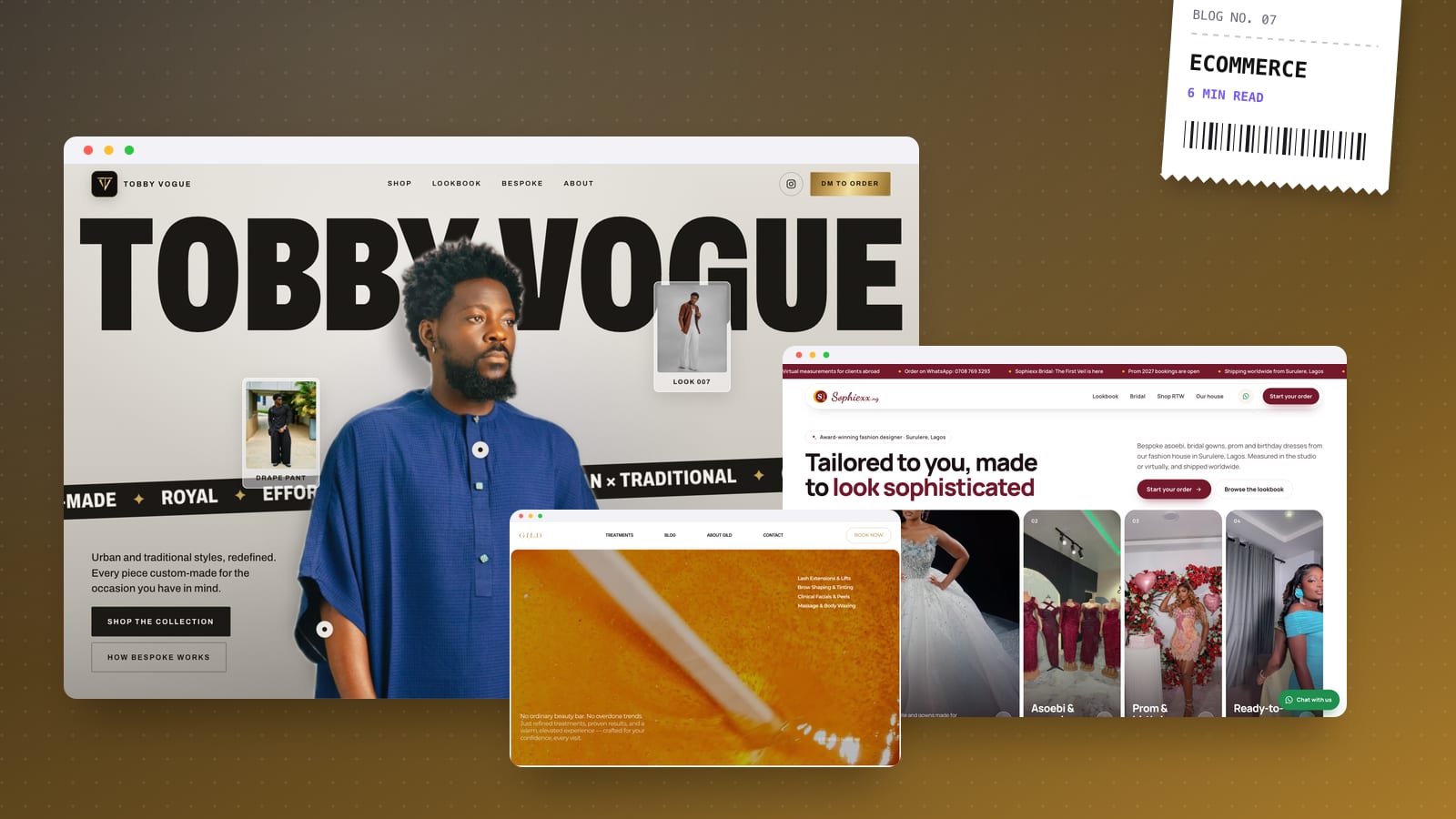
Why nowWritten while designing order flows for fashion labels like Tobby Vogue and Sophiexx.
For most brands launching or growing an online store, Shopify is the right choice: it's faster to launch, reliable, and handles payments, inventory and apps out of the box. A custom (or headless) ecommerce build makes sense when your product, checkout, pricing or content experience can't fit Shopify's model, or when platform fees and app costs start to outweigh the convenience.
I build both kinds of ecommerce stores, and the decision usually comes down to five questions about your catalogue, customers, payments, team and growth plans. Here's how I work through them.
The short version
- Choose Shopify if you sell physical products, want to launch quickly, need a reliable checkout and want your team to manage everything without a developer.
- Choose custom ecommerce if you need unusual product logic, a unique buying flow, deep integration with your own systems, or full control over performance, data and design.
- Consider headless Shopify if you want Shopify's backend (products, orders, checkout) with a fully custom front end.
What Shopify does well
Shopify is a hosted ecommerce platform. You pay a monthly plan plus transaction or payment fees, and in return you get:
- A proven checkout that customers already trust.
- Product, inventory and order management your team can learn quickly.
- A large app ecosystem for reviews, subscriptions, email, upsells, loyalty and shipping.
- Hosting, security and updates handled for you.
- Themes you can start from, plus the option of a fully custom theme.
For a brand selling clothing, beauty products, homeware or similar goods, Shopify covers the vast majority of what you need from day one.
Where Shopify gets limiting
- App creep. Each app adds a monthly fee and often extra scripts that slow the site down.
- Checkout customisation is restricted on standard plans.
- Complex product logic, such as configurators, custom quotes, B2B pricing tiers or bookings, often needs workarounds.
- Content-heavy experiences, like editorial storytelling or lookbooks, can feel constrained inside a standard theme.
- Local payment support depends on what's available in your region, which matters for many African brands (more on that below).
What custom ecommerce does well
A custom store is built on a framework like Next.js with a commerce backend, payment provider and CMS chosen for your needs. It gives you:
- Complete design freedom across every page, including the cart and checkout flow.
- Any product logic you need, from made-to-order configurators to bundles, deposits and custom pricing.
- Performance control, with no third-party app scripts you didn't choose.
- Direct integration with your inventory, ERP, logistics partner or internal tools.
- No platform lock-in on the front end, and fewer recurring app fees.
The trade-offs
- Higher upfront cost and longer timeline. Everything Shopify gives you for free has to be chosen, connected and tested.
- Ongoing maintenance. Someone has to own updates, security and fixes.
- More responsibility for the checkout, which needs to be fast, secure and trustworthy.
Compare total cost of ownership, not launch cost
When founders compare Shopify and custom, they often compare only the build quote. A fairer comparison looks at two or three years: the Shopify plan, transaction fees and every app subscription on one side; hosting, commerce and payment services, and a maintenance budget on the other. For a small catalogue, Shopify almost always wins. For a high-volume brand paying for many apps, or one whose workarounds are costing real hours each week, the numbers can tip the other way.
Headless Shopify: the middle ground
Headless means using Shopify for products, inventory, orders and checkout, while building the storefront yourself in code. You keep Shopify's reliable admin and checkout and gain full control over design, content and speed.
It's a good fit for brands that have outgrown a theme but don't want to rebuild their whole operation. It does add development cost and complexity, so I usually recommend it once a store has real traction, not at launch.
Shopify vs custom ecommerce: side by side
| Factor | Shopify | Custom / headless |
|---|---|---|
| Time to launch | Faster | Slower |
| Upfront cost | Lower | Higher |
| Ongoing costs | Plan, transaction fees, apps | Hosting, services, maintenance |
| Design freedom | High with a custom theme | Complete |
| Product and checkout logic | Standard, extended with apps | Anything you can specify |
| Team editing | Very easy | Depends on the CMS chosen |
| Best for | Most D2C brands | Unique products, flows or integrations |
Ecommerce in Nigeria and across Africa
If you're building an online store in Nigeria or elsewhere on the continent, a few things matter more than the platform name.
Payments
Customers expect to pay with local cards, bank transfer and sometimes USSD. Providers like Paystack and Flutterwave support these local methods and are widely trusted. Before choosing a platform, confirm:
- That your preferred provider integrates cleanly with it.
- Which currencies you can charge in and settle to.
- How refunds and failed payments are handled.
Shopify's available payment options vary by country, so check what's currently supported for your business location. A custom build lets you integrate Paystack or Flutterwave directly into the checkout flow you design.
WhatsApp ordering
Many customers prefer to ask questions or order over WhatsApp. Rather than fighting that, design for it:
- A WhatsApp button on product pages that pre-fills the product name.
- Order confirmations and delivery updates sent where customers already are.
- A clear path from a WhatsApp chat back to a proper checkout link, so payments and orders are still tracked.
Some of this can be automated. My post on AI automations for small business covers order notifications and follow-ups, and my automation service handles the setup.
Delivery and logistics
Delivery is often the hardest part of selling online locally. Plan for:
- Clear delivery zones and fees shown before checkout, not after.
- Pay-on-delivery or transfer options where they make sense for your margins and risk.
- Integration with your logistics partner, or at least a simple way to export orders.
- Realistic timelines stated plainly on product and checkout pages.
Pricing and currency
If you sell locally and internationally, decide early whether to show naira, dollars or both, and how you'll manage price changes when exchange rates move. Platform and app subscriptions billed in dollars also affect your margins.
How I help brands decide
On our first call I'll ask about:
- Your catalogue: how many products and variants, and any special logic.
- Your customers: where they are, how they prefer to pay and how they reach you.
- Your team: who will manage products, orders and content day to day.
- Your integrations: inventory, logistics, accounting, email.
- Your next 12–24 months: markets, wholesale, subscriptions, new product lines.
From there the answer is usually clear. Whichever route we choose, an ecommerce build with me includes store design and product pages, a Shopify or headless build, payment, shipping and tax setup, email capture and abandoned-cart flows, and product data migration. Ecommerce projects start from $3,000 and typically take 3–8 weeks.
If you're also building the brand behind the store, see my brand identity checklist before you start on product photography and packaging.
Planning a new store or outgrowing your current one? Book a 30-minute call. I'll recommend Shopify, custom or headless based on how your brand actually sells, and send a fixed-price quote within a day.